Discover the
Modern
WordPress with WordVell
The McKinsey Global Survey on AI reports that more than 78% of organizations now use AI in at least one business function, a sharp increase from just a few years ago. That figure reflects a shift that’s happening across nearly every industry.
Yet when we look around the WordPress ecosystem, many agencies still run their operations as if it were 2018.
Manual development workflows, manual QA checks, support tickets handled individually, and endless content updates continue to dominate the daily workload.
At the same time, another group of agencies is quietly building something different.
They are integrating AI into their workflows to automate development tasks, content production, SEO analysis, audits, and routine site maintenance.
The goal is straightforward: eliminate hours of repetitive work for developers and operators.
The difference between these two approaches becomes obvious over time. One group struggles with operational inefficiencies and rising costs, while the other delivers projects faster with smaller teams and lower overhead.
This isn’t a talent problem. Most WordPress teams are packed with skilled developers and designers.
The real problem sits in the workflow itself. AI automation is quickly becoming the solution layer.
In practical terms, it’s starting to feel like another professional skill that is required right alongside Git, APIs, and modern JavaScript frameworks.
Agencies that integrate automation into their development and operations will move faster, serve more clients, and unlock entirely new services. Agencies that ignore it will eventually feel the gap.
In this article, you’ll understand why AI automation is becoming essential for WordPress agencies, how some teams are already using it, and what practical tools, such as n8n, developers can use to start implementing AI automation today.
WordPress agencies must now adapt to AI automation because it will give them a competitive advantage across multiple aspects.
Let’s explore why AI automation must be adopted by agencies and developers in 2026:
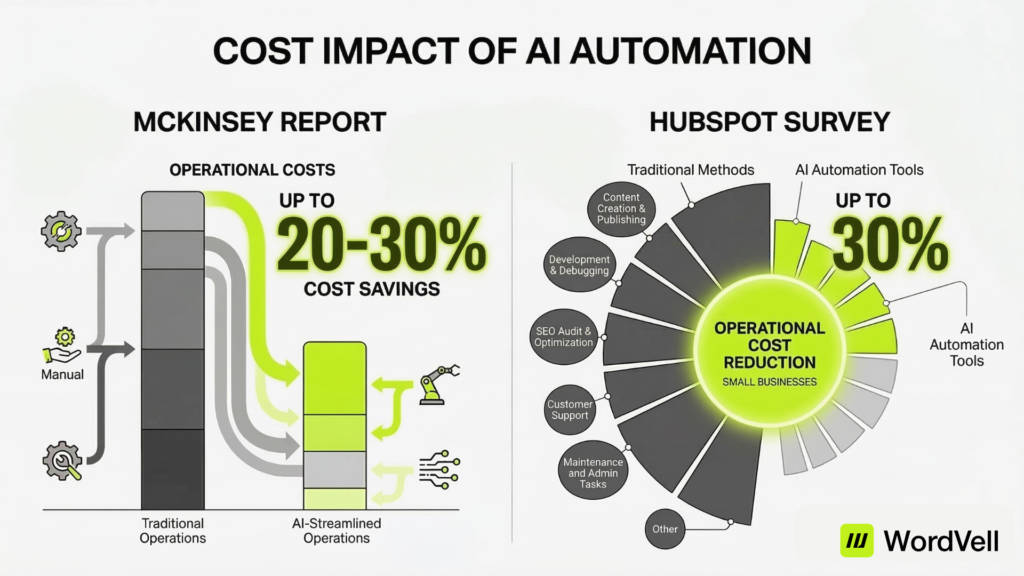
AI automation can reduce your operational costs by up to 30% and also helps you save 40% of time across repetitive and predictable workflows.
The first benefit of AI automation in operations is that it reduces your cost per task across development, operations, and client support.
The McKinsey report indicates that automation could save businesses up to 20-30% in costs by streamlining workflows and reducing manual intervention.
Another survey by HubSpot found that automation tools can reduce operational costs for small businesses by up to 30%.
For agencies operating on tight margins, that shift alone can change the economics of the entire business.
Another aspect on which most WordPress teams struggle is that the dozens of small tasks quietly eat hours every week.
Think about a typical agency week. Debugging small plugin issues, checking compatibility after updates, running performance audits, responding to support tickets, and manually reviewing site health reports.
None of these tasks is intellectually hard, but they are repetitive. And repetition is exactly where automation performs best.
Research backs this up. According to Accenture, generative AI could automate nearly 40% of working hours across industries, especially tasks involving predictable digital workflows.
In practical terms, this translates to small automation systems within agency workflows, which saves a significant amount of cost and time, which you can allocate to more important tasks and activities.
For example, you can build a simple AI automated site audit pipeline using n8n.
When you submit a website URL, the n8n workflow automatically triggers a website crawl with the Screaming Frog API, collects performance data from the PageSpeed Insights API, and sends the results to an OpenAI model to summarize technical issues.
The final report lands directly in Notion or Slack for the team to review.
Tools like Zapier, Make, n8n, the OpenAI API, MCP, and WP-CLI scripts make this surprisingly straightforward to build.
A task that used to take three hours suddenly takes ten minutes.
Technical SEO teams already operate this way. Consultant Aleyda Solis frequently demonstrates automated SEO workflows using APIs and automation pipelines in her learning resources.
The practical takeaway is simple. When you automate repetitive technical work, developers in your team will be able to spend more time building useful features, teams manage more clients without expanding headcount, and the cost per project drops.
Automation doesn’t replace you or your developers. It removes the low-value tasks you and your developers never wanted to spend time on anyway.
Automation allows agencies to deliver more services without expanding the team. When the same number of developers in your team can manage more sites, it leads to an increase in profits and a gain in competitive advantage for your agency.
Most WordPress agencies compete on predictable factors such as Price, portfolio strength, and delivery timelines, which usually decide who wins a project.
Automation quietly changes that competition. Agencies that automate their workflows begin to offer the same services with more efficiency than others.
Think about maintenance services as an example. Many agencies still handle updates, backups, and monitoring manually, which limits the number of client sites a team can realistically manage.
Once automation enters the workflow, the capacity exceeds because you can connect the site with AI using MCP or build an automated workflow using n8n or Zapier and ask it to do all the maintenance in minutes with minimal human intervention.
For agencies, these productivity gains translate directly into competitive advantage or increased profitability.
The broader economic trend supports this shift. A report by PwC estimates AI could contribute $15.7 trillion to the global economy by 2030, largely driven by productivity improvements.
Consider an automated WordPress maintenance system you built with n8n.
A scheduled trigger runs a site health check across all managed websites, which allow AI layer to analyze logs, detect issues, and flag unusual performance drops.
If a problem appears, the system can suggest a fix and send modification approval to the development team in Slack. Finally, also generate a detailed report so that the client receives a clean summary of the issue arised and how it was resolved.
Other tools like n8n, Zapier, ManageWP, WP Umbrella, and custom automation scripts using the MCP servers can also make this workflow practical for agencies today.
In fact, platforms such as n8n already support the development of automated workflow templates, which help with monitoring and maintenance for agencies managing hundreds of WordPress sites.
When systems like this run quietly in the background, agencies stop thinking in terms of “how many sites our team can manage,” But their focus will be on Sales and marketing to grab more clients.
Automation doesn’t just improve efficiency. It increases the operational capabilities that agencies relying on manual workflows cannot replicate.
AI automation dramatically reduces development and delivery time. In agency environments, speed often determines who wins and who loses the project.
Clients today do not compare agencies only by design quality. They ask a question first: how fast can we launch?
Website owners expect rapid revisions, quicker deployments, and near real-time performance insights.
AI coding assistants such as Gemini CLI or Claude Code can help you a lot in speeding up the development.
GitHub reports that developers using AI coding assistants can complete tasks up to 55% faster.
In practical terms, the workflow often looks like this: a developer defines the feature logic for a WordPress plugin, then asks the AI assistant to generate the initial code within seconds.
During debugging, the assistant can also be used to help analyze stack traces or error logs, suggesting likely fixes. It can also generate unit tests automatically, which removes another tedious step from the development cycle.
Tools such as GitHub Copilot, Cursor AI, Gemini CLI, and Claude Code are already being used this way by developers for this purpose across the ecosystem.
Many engineers openly share how these tools speed up everyday development tasks.
At WordVell, for example, we also documented how Gemini CLI (An AI code Assisting Tool) helps us to automate several aspects of our plugin development workflow.
The Stack Overflow Developer Survey also shows that 84% of developers are using or planning to adopt AI code assisting tools for development with 76% increase from last year.
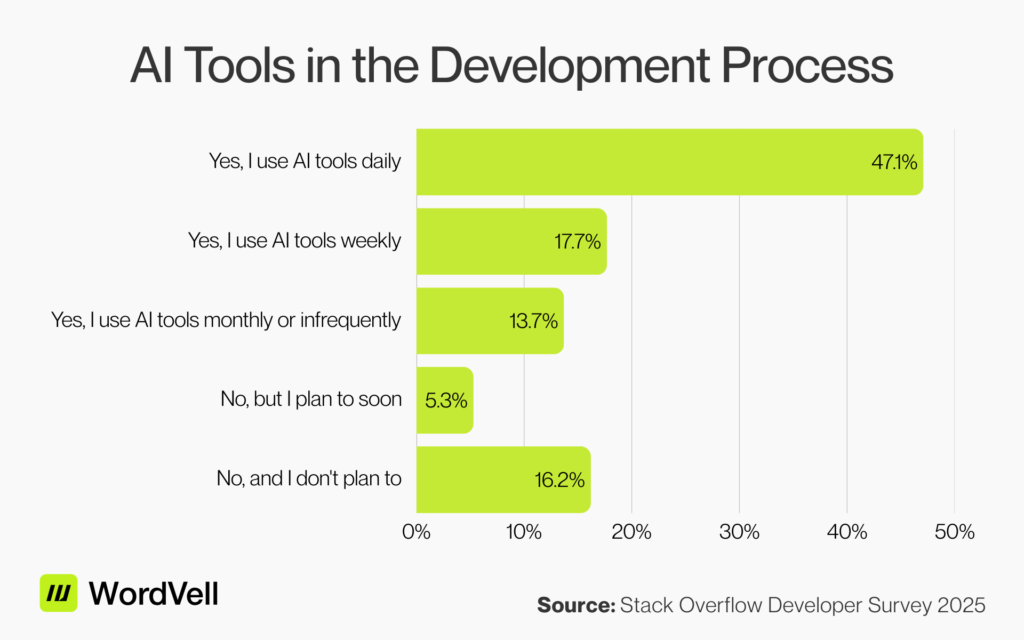
Inside an agency environment, the outcome is straightforward. You can get faster development cycles, which means more projects completed, shorter client waiting times, and healthier cash flow.
So, Speed in development through AI assistants becomes a source of increased revenue for you.
AI automation is not only an internal productivity tool. It also creates entirely new services that you or WordPress agencies can sell to clients.
Many agencies still operate with a simple business model. You build the website, deliver the project, and move on to the next client.
But now Clients are increasingly asking for AI-powered capabilities directly inside their websites and business operations. Website owners want smarter support systems, automated marketing workflows, and personalized experiences that improve how users interact with their brand.
This shift opens the door for agencies that understand automation.
Common services already appearing in agency offerings include
These features move the conversation away from simple web development.
Here you can see the jobs related to automation on Upwork.
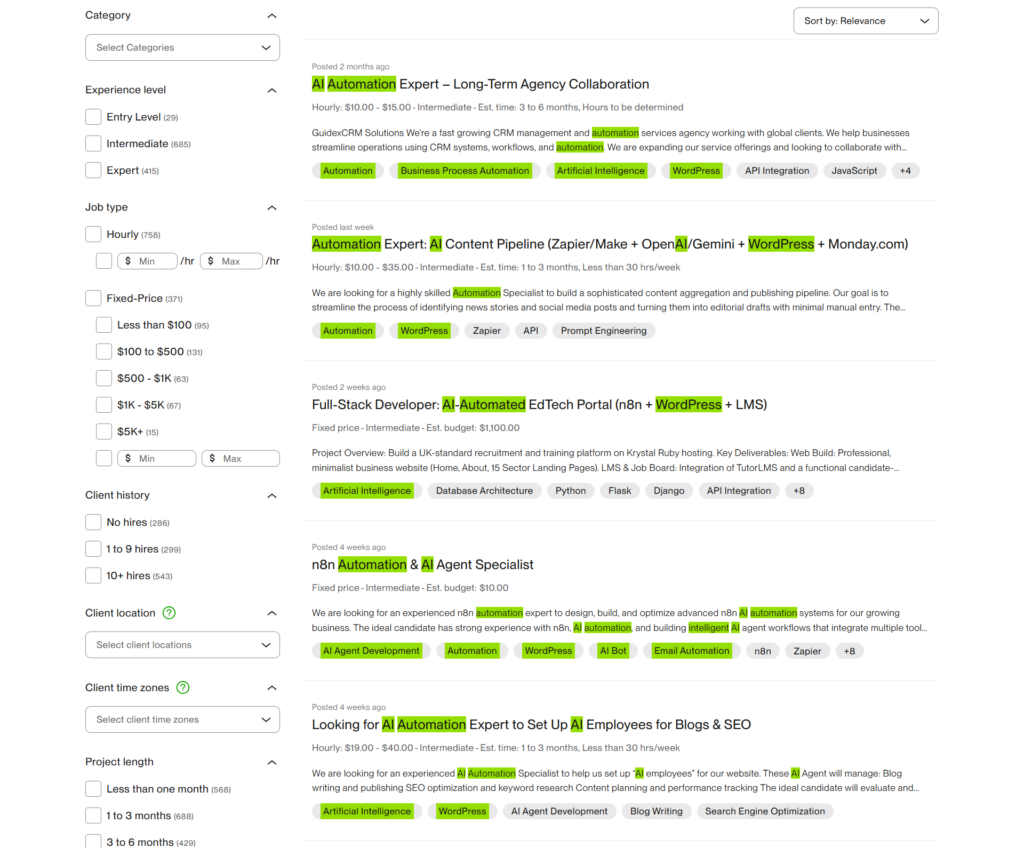
For example, many agencies now offer AI chatbot integration as a packaged service.
Tools like Tidio AI, AI Engine, WPBot, and Hyve AI Chatbot allow WordPress sites to answer common questions, capture leads, and guide users through products automatically.
Over time, this will introduce new income streams. Instead of relying only on one-time build website projects, you can get opportunities to begin offering ongoing AI-powered automation services that clients continue paying for as their business grows.
Before, AI tools only helped you in generating text or code suggestions. But now they are operating as autonomous agents capable of executing your tasks across software systems.
This allows the adoption of automation skills at a large scale in everyday development work, websites, and businesses.
So, you or your WordPress agencie need to catch up with this shift.
Until recently, most AI tools behaved like assistants. We gave a prompt, the tool returned an answer, and the developer decided what to do next.
But the agentic AI shifts this.
The industry is moving toward agent-based AI systems that can monitor environments, analyze incoming data, trigger workflows, and complete multi-step tasks automatically.
Instead of asking AI to perform a single action, you define a goal and let the system coordinate several steps to reach it.
Major technology companies are investing heavily in this direction. Research from Microsoft highlights the rise of AI agents designed to perform complex workflows that previously required multiple human actions.
Inside WordPress operations, the practical applications are becoming easy to imagine.
Consider you connect a group of client websites with an AI agent that is built using n8n. The agent continuously checks uptime, page speed performance, site issues, and basic SEO health indicators.
If a problem appears, the system begins its own troubleshooting process. It diagnoses the likely cause, proposes a fix, and either creates a ticket for the development team or applies a safe automated patch.
Beyond n8n, Tools like AI Engine, MCP Servers for WordPress, Zapier, Claude Cowork, and emerging OpenAI agent frameworks can help you with these kinds of workflows.
Developers and agencies who start learning and adopting automation frameworks today will be much better prepared for this shift.
As agent-based systems mature, agencies that understand how to design and supervise these workflows will hold a major operational advantage and also unlock new revenue streams.
Traditional SEO is evolving faster than most agencies expected. If you want your clients’ websites to stay visible, you now have to think beyond search rankings and start optimizing for Generative Engine Optimization (GEO).
Search behavior is already shifting. Instead of clicking through multiple websites, many users now rely on AI-generated summaries provided directly inside search interfaces.
We see this with platforms like Google AI Overviews, Bing Copilot, and Perplexity, where the answer appears immediately without requiring the user to visit several pages. For publishers and agencies, that changes how content gets discovered.
The scale of this shift is significant. Research from SparkToro shows that nearly 60% of Google searches now end without a click, meaning users often find the information they need directly in AI overviews of search results.
The Semrush research predicts that LLM visitors will surpass Google Search visitors by 2027.
That reality forces agencies to rethink content optimization strategies.
Automation can play a major role here. Instead of manually structuring and optimizing every page for search engines and LLMs, AI workflows can assist with generating structured content blocks, automating schema markup, mapping entities, and expanding semantic coverage across related topics.
A simple GEO-focused workflow might start with an AI system analyzing search queries and identifying key entities connected to the topic.
The tool then generates a structured schema, expands supporting questions, and improves the semantic context of the page.
Dozens of SEO professionals already use automation pipelines for tasks like optimizing content, generating FAQ schema, building entity-based content structures, and producing structured summaries that AI search systems can easily parse.
You can find multiple automated SEO workflow templates for WordPress at n8n website.
When WordPress agencies combine AI automation with GEO-focused content strategies, they position their clients to appear not only in traditional rankings but also inside AI-generated search answers.
WordPress agencies are entering the era of AI automation. The agencies that succeed over the next few years won’t just build websites better, but they will run smarter operations powered by automation.
In practice, that means integrating AI into their internal workflows and, as well as, into client projects at the same time.
Agencies that treat automation as part of their production system will move faster, operate more efficiently, and deliver capabilities that clients increasingly expect.
AI automation already helps agencies reduce operational costs, accelerate development cycles, unlock new service offerings, and adapt to emerging AI-driven search ecosystems. Each advantage compounds over time.
For WordPress developers and agency owners, the debate is practically over. AI automation is no longer a future trend or a nice-to-have feature; it is a vital skill to master in order to stay competitive in the AI automation age.
Now, your mind should not be focused on this:
“Should we use AI automation?”
Rather than, your focus should be on:
“How quickly can we integrate automation into our workflows before our competitors gain an advantage?”
So, before winding up, if you want to learn more about AI-native WordPress, then subscribe to our newsletter.